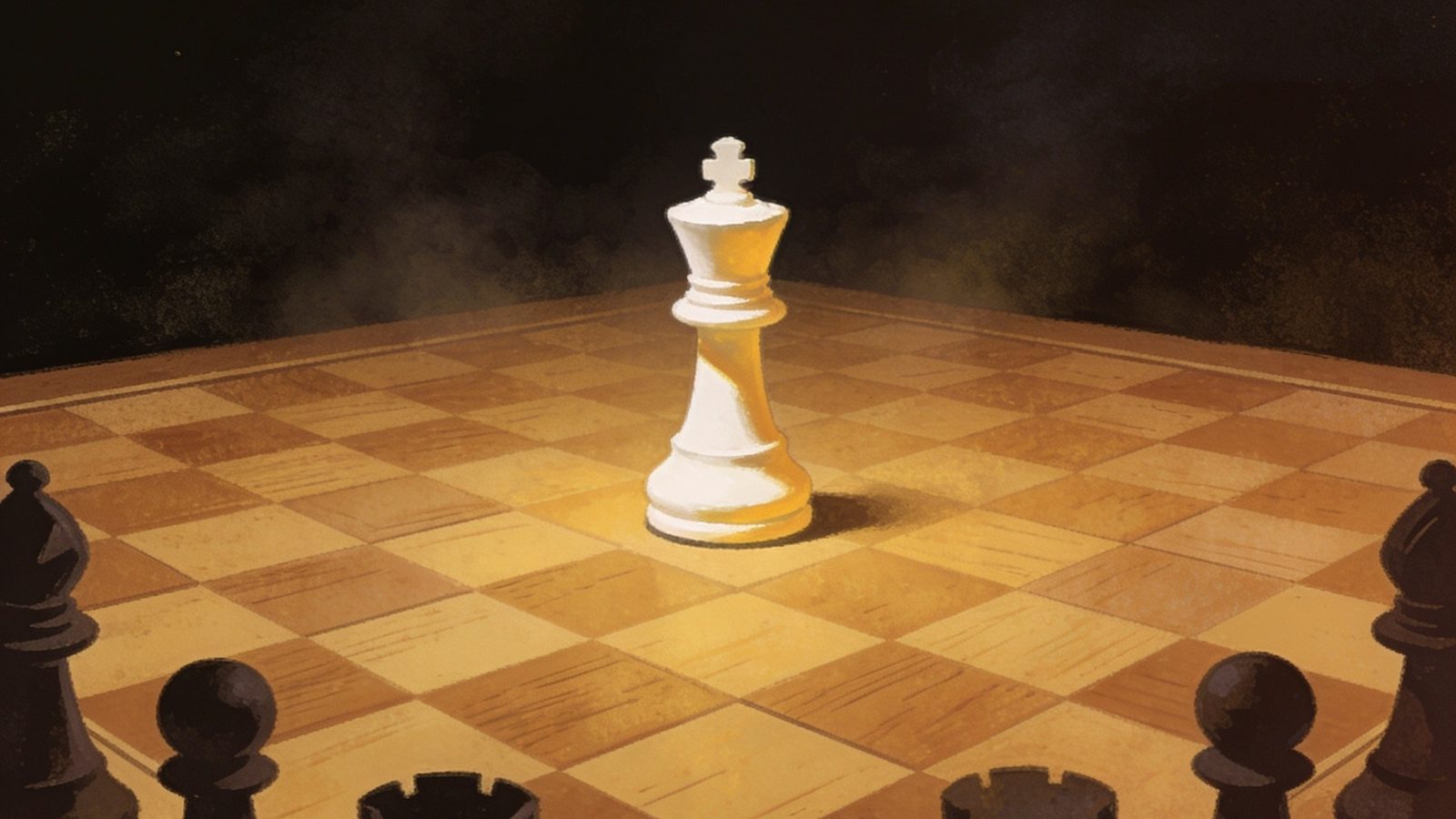
Every chess position hands you the same order: move. You can't pass. In most situations that rule is your friend — it's how you make progress. But once in a while, having to move is the entire problem.
That's zugzwang: a German word (Zug, "move" + Zwang, "compulsion") for a position where the player to move is at a disadvantage precisely because they must move, and every legal move makes their position worse. Whoever is stuck in it isn't losing to a threat. They're losing to the game's own rule — obliged to worsen their own position, one move at a time.
The idea is ancient. It appears in shatranj studies from the early ninth century, and in an endgame study by the Italian Giulio Cesare Polerio from 1585, which Alessandro Salvio published in 1604. Players understood it more than a thousand years before anyone gave it a name.
The word itself is younger and German. German chess writers were using it by at least 1858, when the Deutsche Schachzeitung ran an unsigned article titled "Zugzwang, Zugwahl und Privilegien." English picked it up much later — the first known English use is commonly dated to 1905, in Emanuel Lasker's Chess Magazine — but it stayed a niche term until the 1929 translation of Nimzowitsch's My System. The translator, Philip Hereford, left "zugzwang" untranslated because no single English word captured it. He was right; none does.
Two famous endgames show how it bites.
The Saavedra position (1895) is a rook-versus-pawn ending whose result depends almost entirely on whose turn it is to move. Everything is timed around tempo, arranged so the side to move is the side squirming — a picture-perfect demonstration of why an extra move isn't always a blessing.
Zugzwang also powers the most basic mate in the game. King and rook against king is won not by brute force but because the defender eventually runs out of room and must step aside into a losing move. Fewer pieces, fewer moves. That density is exactly why zugzwang feels like an endgame theme: strip the board down, and there's often one killing move left, and it's the one you're forced to play.
The extreme case is the "Immortal Zugzwang Game," Fritz Sämisch against Aron Nimzowitsch, Copenhagen, March 1923. It's famous partly because zugzwang in the middlegame is nearly unheard of — with so many pieces there are usually too many spare moves. Here Sämisch is up material and still has nearly all his pieces, yet every move is a concession. Nimzowitsch, who had given up material for the bind, trims his options until Sämisch resigns, almost paralysed. One honest caveat: some writers dispute that this is a true zugzwang, since Black held a real threat at the end. Whatever you call it, it's the game everyone reaches for to show what the compulsion to move really feels like.
Keep the endgame theme going on our sister site, Stack Signal.