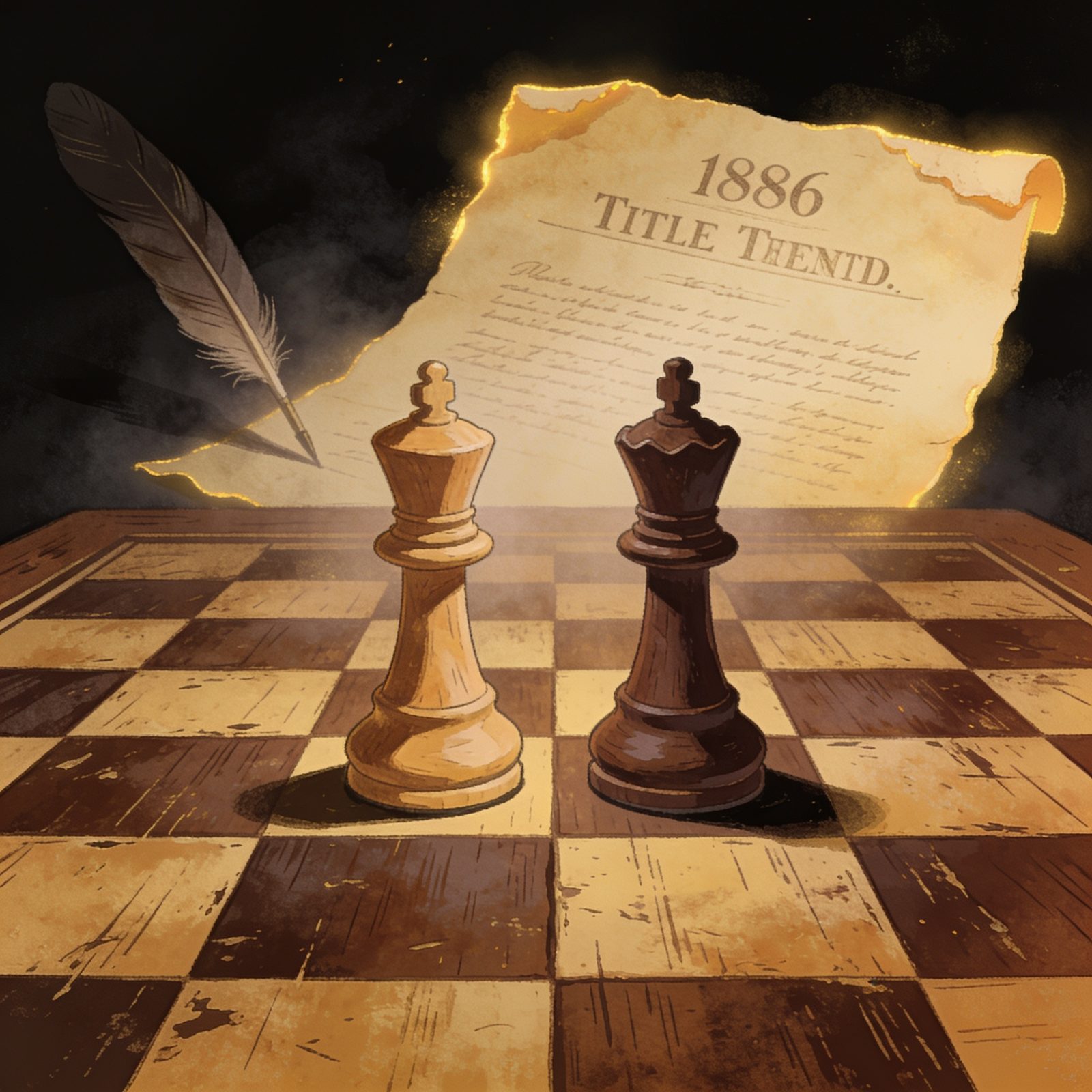
There is a before and an after to the game of chess, and the dividing line runs through the spring of 1886. Before it, being the world's best player meant having an opinion — and, often, a rival who disagreed. There was no belt, no ceremony, no certificate. The strongest men in the game simply played, and their reputations travelled by word of mouth. All that changed when two of them decided to settle the question once and for all, with the whole world watching and two thousand dollars a side on the table.
A title with no owner
Nobody owned the world championship before 1886. No federation awarded it, no tournament produced it, and no player could claim it outright. Wilhelm Steinitz and Johannes Zukertort were the two clear leaders of the day, and so they did what players did: they agreed to play. The terms, settled on 29 December 1885, called the match "for the Championship of the World." First player to win ten games would take the title, with draws counting for nothing. That simple agreement — made between two men, enforced by nothing but honour — invented the World Chess Champion.
Twenty games in three cities
The match ran from 11 January to 29 March 1886, and it moved as it played. The first five games happened in New York. Zukertort came out like a storm, winning four of them to open a 4–1 lead. Steinitz, the pragmatist from Prague, did not panic. In St. Louis he went to work on the details, taking games 6, 7, and 9 to even the score at 4–4. The third leg, in New Orleans, decided everything. Steinitz won six more games to Zukertort's one; the rest were drawn. On 29 March, in the twentieth game, Zukertort resigned and congratulated the new champion. Final score: 10–5, with five draws.
A new way of playing
Steinitz left the board with more than a title. He carried a philosophy. Where others attacked on impulse, he built small advantages and waited for them to ripen. He held that a player should only strike when he held the initiative — an idea so quiet and so powerful that it came to define serious chess for a generation. His rivals dismissed his style as timid. History called it the modern school. Steinitz held the crown he had created until 1894, when Emanuel Lasker beat him. Zukertort, his old rival, lived only two more years; he died in 1888.
Every world champion since has traced a line back to that agreement in December 1885. No trophy, no feuding organizers, no prize fund from a distant sponsor — just two men, twenty games, and the decision that the world's strongest chess player deserved a title to prove it.