
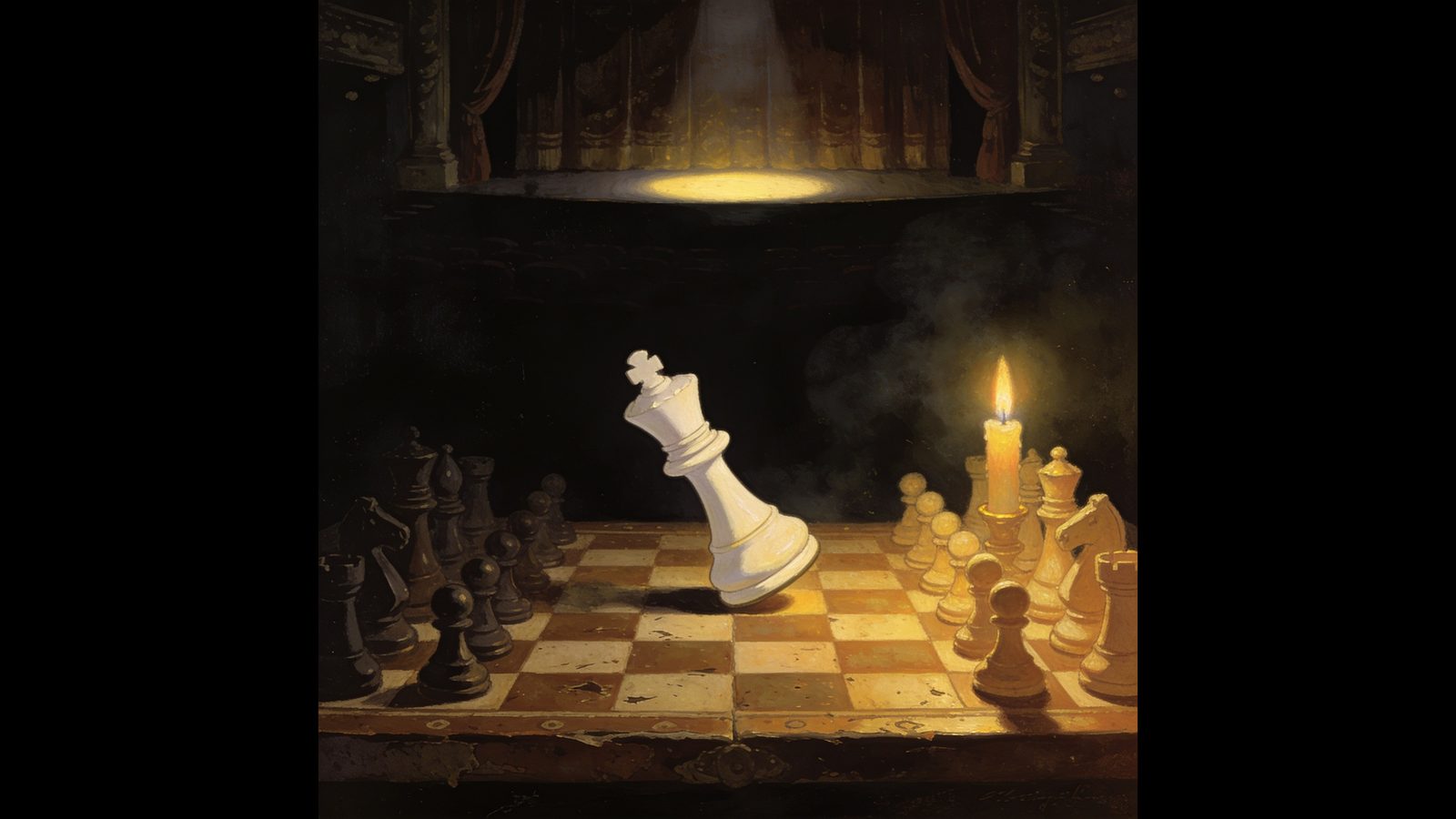
There was a time when chess was less a science and more a dare. In the middle of the 1800s, the strongest players in the world did not sit back and develop quietly. They flung material at each other, gave up bishops and rooks for open lines, and chased the enemy king with a fearlessness that reads today like theatre. We call it the Romantic era, named in the loose spirit of the Romantics who treasured passion over caution. It held the game from the early 1840s into the 1880s, and its true masters were the attackers who believed a king under siege mattered more than any pile of pieces.
The 1840s belonged largely to Howard Staunton, the Englishman who gave his name to an opening. Around him rose a generation that defined the age: Adolf Anderssen, Daniel Harrwitz, Henry Bird, Louis Paulsen, Paul Morphy, and Joseph Henry Blackburne. Men who played, so the legend goes, for the beauty of the blow.
The Immortal Game, 1851. The era's signature moment came in London, in a year that rewrote chess history. That summer Staunton organized the world's first international chess tournament, the London 1851 event. A teacher of mathematics from Breslau named Adolf Anderssen won it, and came to be widely regarded as the champion of the world. But the game everyone remembers did not happen in the tournament at all. During a break, Anderssen sat down for an informal, friendly game with Lionel Kieseritzky — also a teacher of mathematics — and produced what many still call one of the most beautiful games ever played.
We are told Kieseritzky was so taken with the position that he telegraphed the moves to his club in Paris. The French journal La Régence printed the game in July 1851, and in 1855 the Austrian Ernst Falkbeer gave it the name that stuck: the Immortal Game.
What made it immortal was the scale of the sacrifice. Anderssen gave up a bishop on move 11, both rooks from move 18, and his queen on move 22 — all to build a mating net. When the dust settled, Kieseritzky was ahead in raw material, holding a queen, two rooks and a bishop against Anderssen's few minor pieces. Yet the material did not help. A queen, two rooks and a bishop could only watch as Anderssen's remaining men delivered mate. The record is not perfectly tidy — the exact date and venue are uncertain, and the concluding mate may never have been played on the board at all — but no hedge dims the point: it is not what you hold that wins, but what your pieces can do.
The Opera Game, 1858. Seven years later, the American master Paul Morphy, about 21, stepped into a private box at the Salle Ventadour theatre in Paris. He was there for the performance, but his opponents were not in the cast. Two amateurs — the German Karl II, Duke of Brunswick, and the French aristocrat the Comte Isouard de Vauvenargues — sat across from him in consultation, the pair of them jointly deciding the black moves while Morphy alone handled white.
The record will not settle the details, and it is honest to say so plainly. The best-supported reading points to Rossini's The Barber of Seville on 4 November 1858; tradition often prefers Bellini's Norma, and the commonly repeated "2 November" is probably impossible, since no opera played at that theatre that night. So we hedge, and we enjoy.
The game itself fit Morphy's genius. In seventeen moves he ripped open the Duke's position, developed with brutal purpose, and finished by giving up his queen to force mate while both aristocrats looked on. It became one of the most-taught attacking games in chess — a masterclass in how initiative, not material, drives a fight.
The Romantic era faded as the century closed, overtaken by a more scientific, positional chess. Yet its lesson never really left the game. Spend everything on a dream and count the cost later — the Immortal and the Opera are chess's proof that sometimes the most generous move is also the most logical one.
If these lost stories move you, our friends at Hermes News keep an archive of old chess alive.