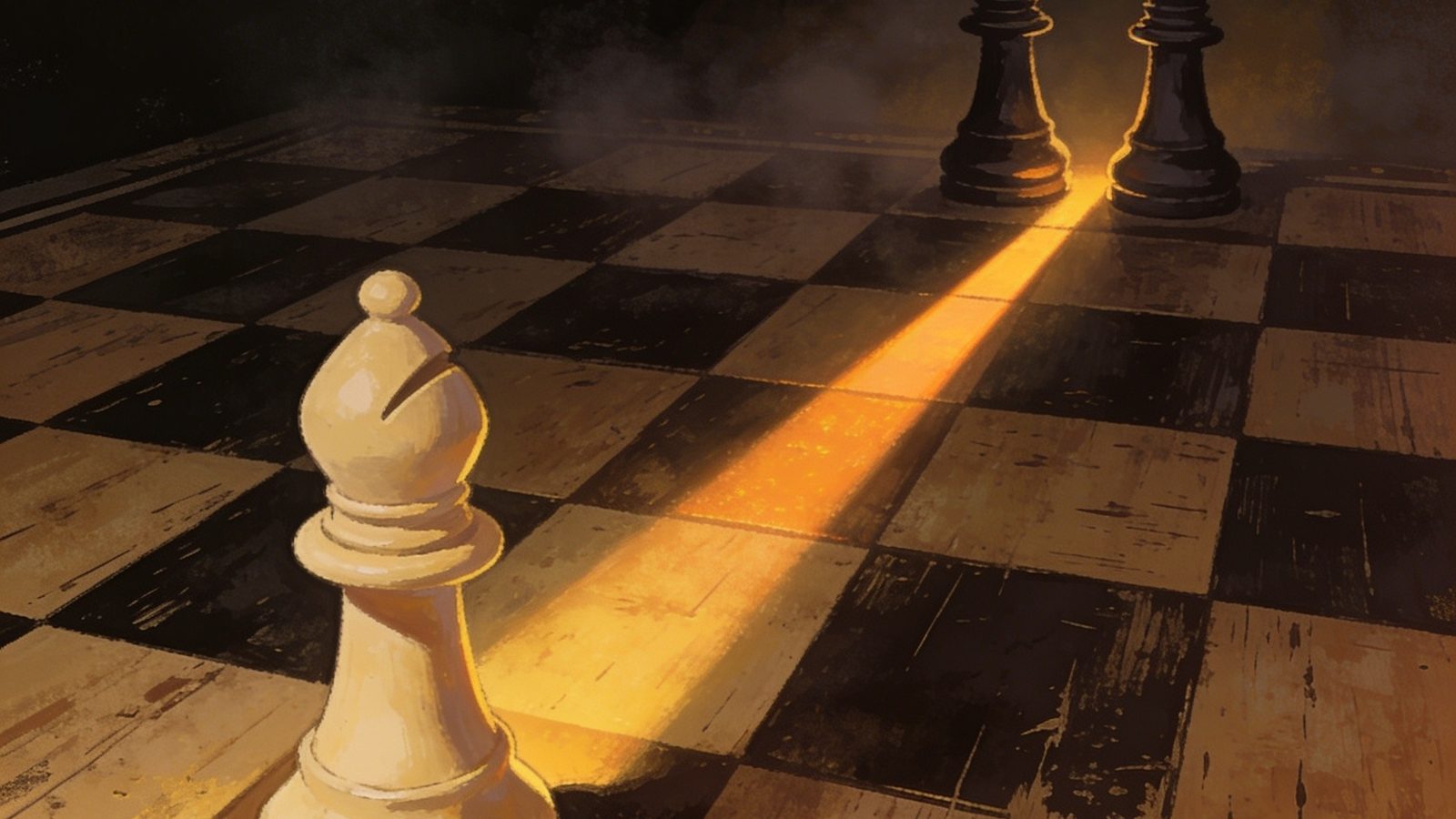
A pin freezes a piece in place because moving it would expose a more valuable piece behind it. A skewer flips that: it attacks the valuable piece directly and swallows the cheap one behind it when it runs. Same straight line, reversed targets — and once you see them, they're hard to unsee.
The Pin: Freeze the Piece in Front
A pin does exactly what its name suggests: it freezes an enemy piece in place. Imagine a rook on f1, facing the enemy queen on e4, with an enemy rook on e5 sitting right in front of the queen. The f1 rook attacks straight along the file, straight through the rook on e5, into the queen behind it. If the e5 rook moves, the queen gets taken. So that enemy rook is stuck — that's a pin.
Two kinds of pin matter here. In an absolute pin, the piece behind is the king. Moving the pinned piece would expose your own king to check, which is illegal. That piece may as well be glued to the board. In a relative pin, the piece behind is valuable but not royal — moving the front piece loses material, but it isn't against the rules.
Here's the prick of it: only the long-range pieces — the queen, rook, and bishop — can throw a pin, because only they attack along a whole open line. Knights, kings, and pawns can't reach far enough to pin anything.
The Skewer: Same Line, Flip the Target
A skewer is the mirror image, and this contrast is worth locking in. Instead of attacking the cheap piece in front to reach the valuable piece behind, you attack the expensive piece directly — it's now in front — and the cheaper one hides behind it. When the front piece steps aside to safety, the piece behind gets swallowed. Some players call a skewer an "x-ray attack," because the attacker seems to see straight through the first target to the meat behind it.
Picture a bishop aimed down the diagonal at the enemy king, with the enemy queen one square directly behind the king. The king must move out of check, and the queen is now sitting in the bishop's line, defenseless. That's a skewer done properly. Same long-range pieces, same straight line — just reversed priorities.
The Common Anatomy, and Two Sharp Edges
Both tactics rest on the same skeleton. An attacker's long-range piece faces two of your pieces lined up in a single straight line along a rank, file, or diagonal. That line is the whole setup. Guard your pieces against lining up, and you blunt both weapons at once.
Two details sharpen the picture. A cross-pin happens when one piece is pinned in two directions at once — squeezed between two attackers on crossing lines, it's nearly helpless under that kind of pressure. And on defense: a pinned piece is often best handled by piling more attackers on it, pressuring it rather than rushing a trade. When you're the one being pinned, break the pin by sliding the protected back piece out of the line, or squeeze a blocker between the attacker and the target. To dodge skewers, keep your valuable pieces spread apart instead of stacking them on one file.
See the line, name the tactic, and grab the advantage. Want more craft like this? The crew over at Stack Signal is always digging into the finer points of the game.