
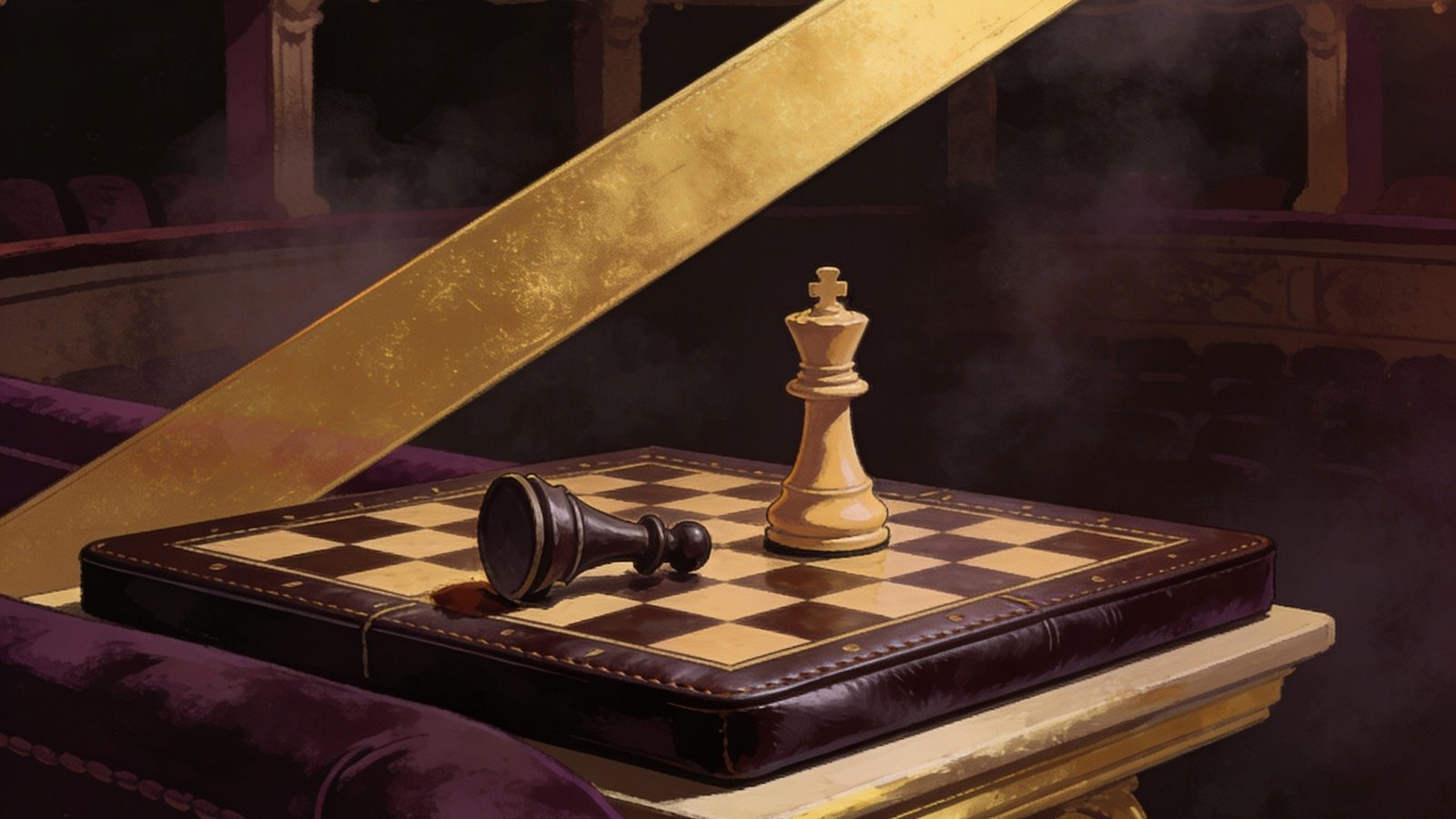
Some games age into textbooks. The Opera Game aged into a legend — and it earned every year of it.
Paris, 1858. A private box in the Salle Ventadour. On stage, an opera — which one, historians still dispute, so it is commonly said only that singing filled the hall. In the box, a second performance. Paul Morphy, the great American attacking genius of the nineteenth century, sits with his back to the stage. Across from him, the German noble Karl II, Duke of Brunswick, with the French aristocrat Comte Isouard de Vauvenargues at his side. The two gentlemen consult together and decide every black move; Morphy answers every one alone.
Morphy was, by all accounts, half miserable — he loved the music and would happily have wished the chess to Pluto. But the moment the pieces moved, misery turned to mastery.
The opening was the Philidor Defence (ECO C41), played in October or November of that year. As early as move three, Black sent a bishop out to grab a pawn: 3...Bg4. Bobby Fischer, analyzing the game a full century later, called that a weak move — and he was right. That one greedy grab handed Morphy the thing he prized above all else: a head start in development.
What follows is the cleanest teaching game in chess. Morphy does not snatch pawns back. He brings his army out — knights to attacking squares, bishops onto open diagonals, rooks onto open files — while Black keeps reaching for small material and bleeding tempos in return. Then comes the move that made the game famous. At move 10, Morphy offers a knight for a single pawn: 10.Nxb5!. Wilhelm Steinitz called that instant "the first link in the chain of a most beautiful combination."
Here is the truth that move teaches. Sacrifice, done right, is not recklessness. It is trading material you can spare for time, files, and initiative — because the only real target is the king.
The finish is the part every coach replays. At move 16, Morphy plays 16.Qb8+! — he gives up his queen, forcing Black to take her. To the puzzled eye it looks like a blunder. Then comes the quietest, most crushing move in the game: 17.Rd8#. Mate. The rook glides in, the check has no answer, and the king falls. Seventeen moves. One idea holding them together: develop every piece, never move the same one twice, and spend whatever you must to reach the king.
Why should a learner care about a game nearly 170 years old? Because most games are lost early the same way — one piece doing all the work while the rest sit at home. Watch Morphy's first ten moves and you see the opposite habit: bring everything out, wrap a net around the enemy king, then strike. Steinitz's "chain of a most beautiful combination" is exactly that lesson. A mating attack is never one lucky move, but a sequence where every piece pulls one thread.
So the takeaway, in one line: develop your pieces, do not keep pushing the same one, and remember that a sacrifice is only reckless when it buys nothing. When the target is the king, no piece is too dear.
For more on the games and players who built modern chess, see Stack Signal