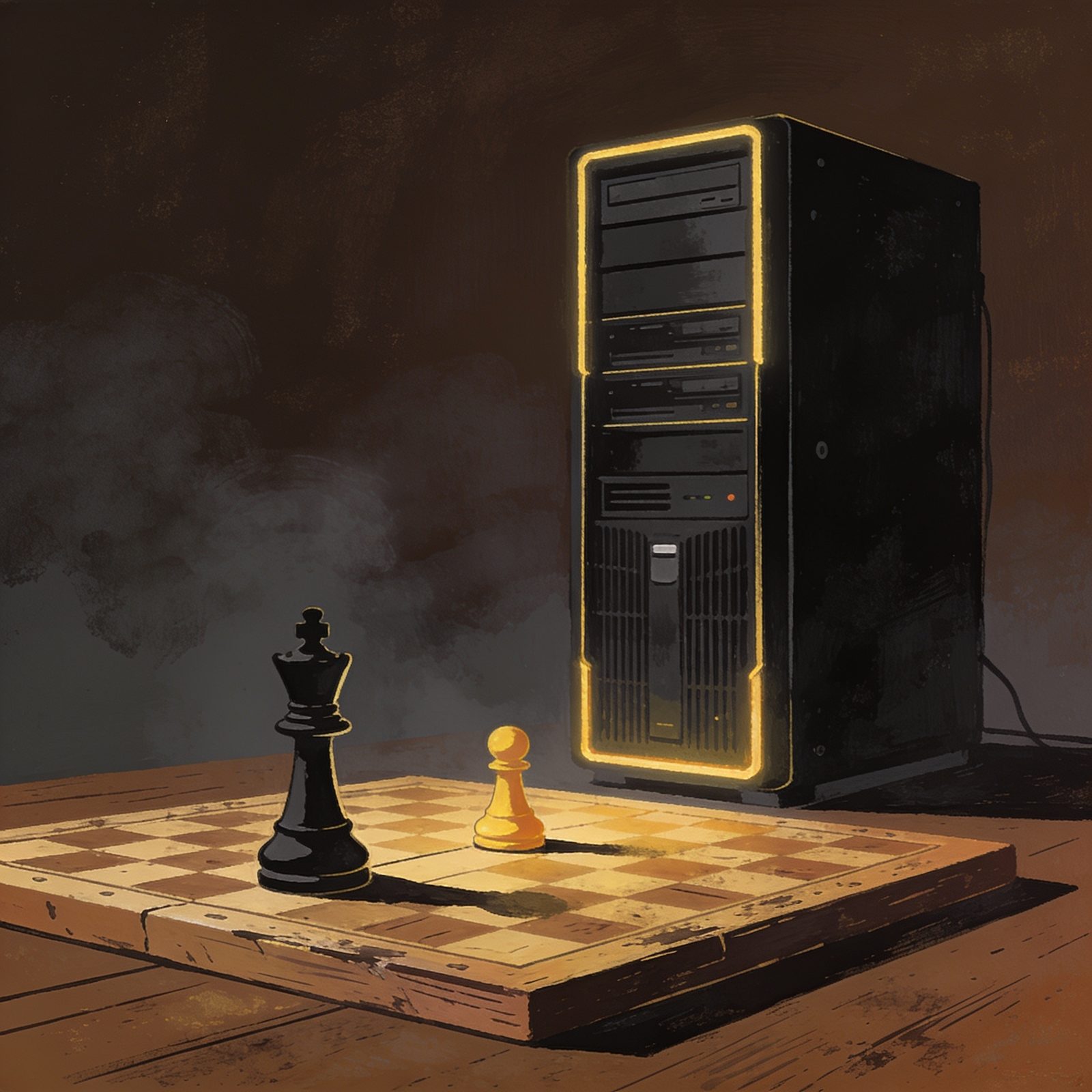
There is a moment every chess player remembers, whether or not they were alive for it. May 11, 1997, in New York City. Garry Kasparov, the greatest human player of his era, sits across from a humming black tower of IBM silicon. Game six of six is underway, the match deadlocked at two and a half points each. Almost twenty minutes pass before Kasparov makes his fifth move. Nobody knows it yet, but history is about to turn.
The story really starts a year earlier. In February 1996, in Philadelphia, Kasparov played IBM's Deep Blue for the first time, a six-game match. It made news immediately when the computer took game one — the first time a machine had won a full classical game against a reigning world champion under tournament conditions. But Kasparov steadied, won the next game, and closed out 4–2. The champion had won. The story, everyone assumed, was over.
It wasn't. The IBM team took Deep Blue apart and rebuilt it, roughly doubling its firepower until it could evaluate about 200 million positions a second across 256 processors working together. The rematch opened in New York on May 3, 1997. Kasparov won game one. Deep Blue won game two. Then came three draws in a row, and suddenly a six-game match had come down to one deciding game.
What happened in game six has been argued ever since. Kasparov steered into territory that raised uncomfortable questions about the machine's judgment — a move the humans behind Deep Blue had seemingly not accounted for — and it collapsed quickly. Deep Blue won the decisive game in just 19 moves, taking the match 3.5–2.5 and doing something no computer had ever done: beat a reigning world champion in a full match under tournament rules.
The victory was a public-relations triumph for IBM and an open wound for the champion. Kasparov accused the team of human assistance. When he demanded a rematch and asked to see the computer's records, IBM declined and instead retired Deep Blue, sending it to the Smithsonian in Washington, D.C. To this day, some of the machine's analysis from that week has never been published. Kasparov and his fans were left, fairly or not, with the lingering sense of unfinished business — the English-language phrase "the match that never got its rematch" sticks to it for a reason.
Why does it still matter? Because this is where the modern reckoning with machines actually begins. Chess had been the great test bed of human calculation, the game we used to measure our own minds. When a reigning champion lost cleanly to a computer in the spring of 1997, it stopped being a hypothetical. It changed how we talked about artificial intelligence, and it quietly reshaped chess itself — the opening books deepened, the training habits shifted, and the game the rest of us play today owes a quiet debt to that week in New York.
Kasparov remained world champion until 2000. But on that Sunday in May, the crown's meaning changed. He had lost to a machine, and nothing would ever quite be the same.
Way back at the start of a long line of man-versus-machine showdowns, this is the one that lit the fuse. If you want the story behind how chess engines turned into the shadows we all carry to the board, start here — https://stacksignal.fdhcl.com