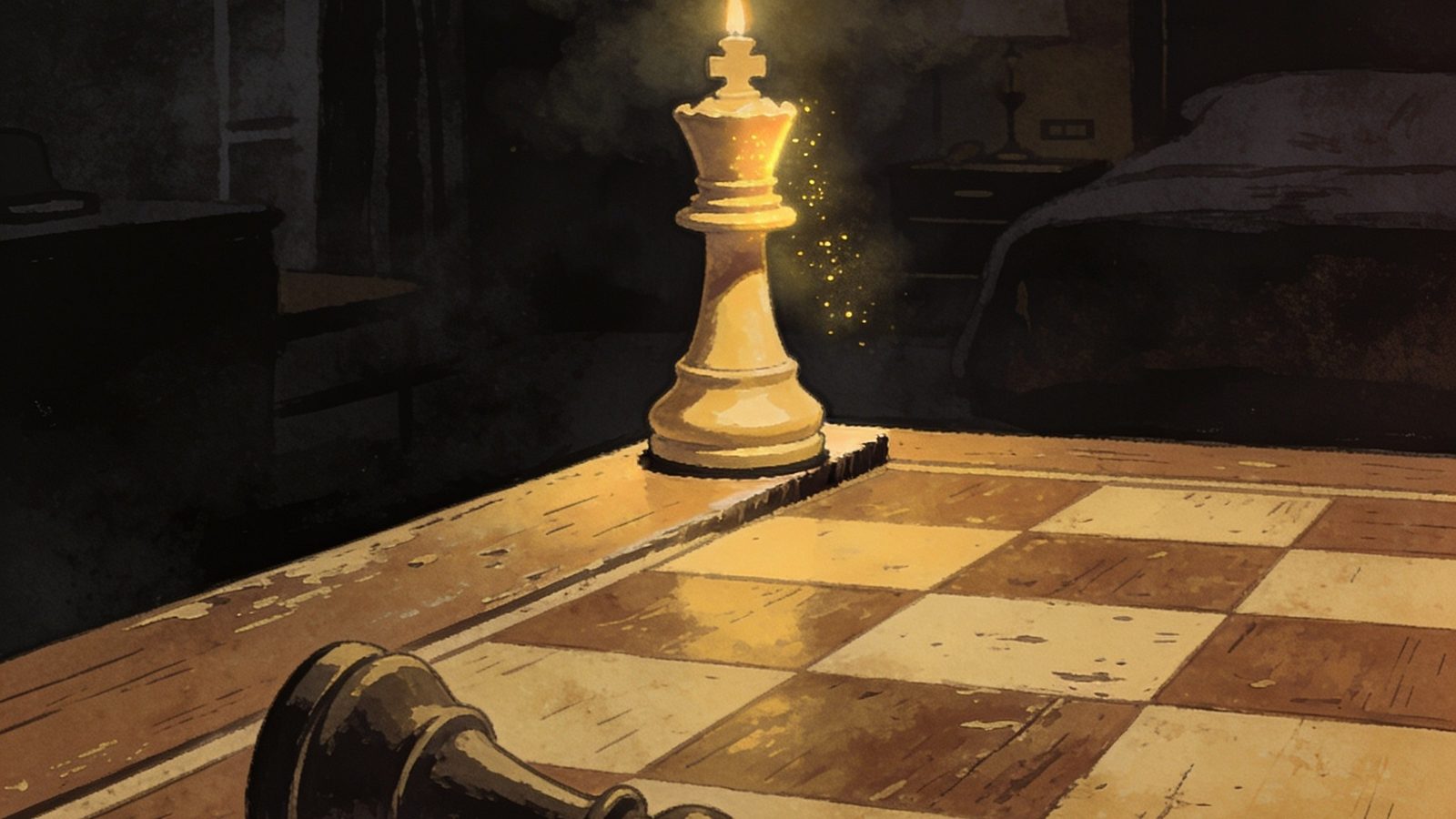
There is a photograph of Alexander Alekhine, taken near the end, slumped over a chessboard in a hotel room in Estoril, Portugal. He is 53, the reigning world champion, and he is dead. The pieces on the board sit on their starting squares, as if a game was about to begin. It never did.
Alekhine was born in Moscow on 31 October 1892, a boy who learned chess young and dreamed of the crown. He reached the top of the chess world in 1927 in Buenos Aires, and he did it against the man everyone thought was unbeatable: José Raúl Capablanca, the great Cuban, whose calm, almost effortless clarity had made him look invincible. Alekhine had never beaten Capablanca in a single game before that match. Then he won it — six wins, three losses, twenty-five draws — in the longest formal world championship match of its era. The chess world was stunned. The "invincible" man had fallen to a challenger who had never once taken a game off him.
Alekhine's style was the opposite of Capablanca's. Where Capablanca simplified and clarified, Alekhine complicated. He was the most attack-minded of all the world champions — a player who trusted the attack, who believed that a position could be made to yield more than it seemed to promise. He combinated spectacularly, played with ferocious aggression, and even set blindfold chess records in 1924, 1925, and 1933. He emigrated to France in the early 1920s, became a naturalized French citizen, and represented his adopted country after 1925.
In the early 1930s he dominated tournament play and defended his title twice against Efim Bogoljubov, in 1929 and 1934. Then came the fall. In 1935 he lost the world championship to Max Euwe of the Netherlands — a defeat that shocked his admirers. But Alekhine did something no world champion had ever done before: he won the title back. In the 1937 rematch in the Netherlands he reclaimed his crown decisively, ten wins, four losses, eleven draws. He remains the first champion to lose the title and then reclaim it.
The end is a mystery. In 1946, negotiations had begun for a title match against the young Soviet star Mikhail Botvinnik. Alekhine died suddenly in his hotel room in Estoril before it could happen. The death is usually attributed to a heart attack, though the circumstances remain debated to this day. He is the only world champion ever to die while still holding the title.
What does Alekhine have to teach a learner today? More than the flashy combinations, I think. His lesson is about courage — the willingness to complicate the game instead of running from it, to trust the attack even when the safe move looks easier. Capablanca showed that clarity wins. Alekhine showed that a position worth fighting for is worth making messy. For a player who wants to grow, that is a gift: the permission to be bold, to create tension, to believe that the board can reward imagination.
He was complicated, flawed, and brilliant — a man who lived hard and played harder. The board in that Estoril hotel room was set for a game that never began. But the games he did leave us are more than enough to study, and to love.
Want more stories from chess history? Explore the archives at Tama.